
No provenance
A chunk comes back, but nobody can say where it came from, how sure the system is or whether it is still true.

Named for the Titaness who remembered everything. Long-term memory for your agents that knows what was true, when, and who may see it. Self-hosted, on your own Postgres.
Lethe · Why it exists
In the myth, the dead drank from the river Lethe and lost everything they knew. An agent does the same when a conversation ends. Pasting chunks from a vector store into the prompt hides it, and adds three problems that grow with scale.
A chunk comes back, but nobody can say where it came from, how sure the system is or whether it is still true.
“Acme is on Pro” and “Acme upgraded to Enterprise” are both just vectors. Nothing says which one holds today.
Memory shared by several customers and separated only by a WHERE clause is one forgotten clause away from a leak.
The underworld had a second spring, and it was Mnemosyne’s: whoever drank from it remembered. Here it is a server. It stores typed memories with their source, their confidence and the period in which they hold, and lets the database keep each workspace apart.
It fits if your agents serve several users or customers, you need to audit what an agent knew at a given moment, or you want the memory on your own infrastructure.
It is more than you need if you have a single-user notebook that only wants similarity search. Plain pgvector will do.
The atrium · The dashboard
Memory was a palace long before it was a database: you leave each thing in a room and walk back to it. The dashboard is that palace, and every room has one job.
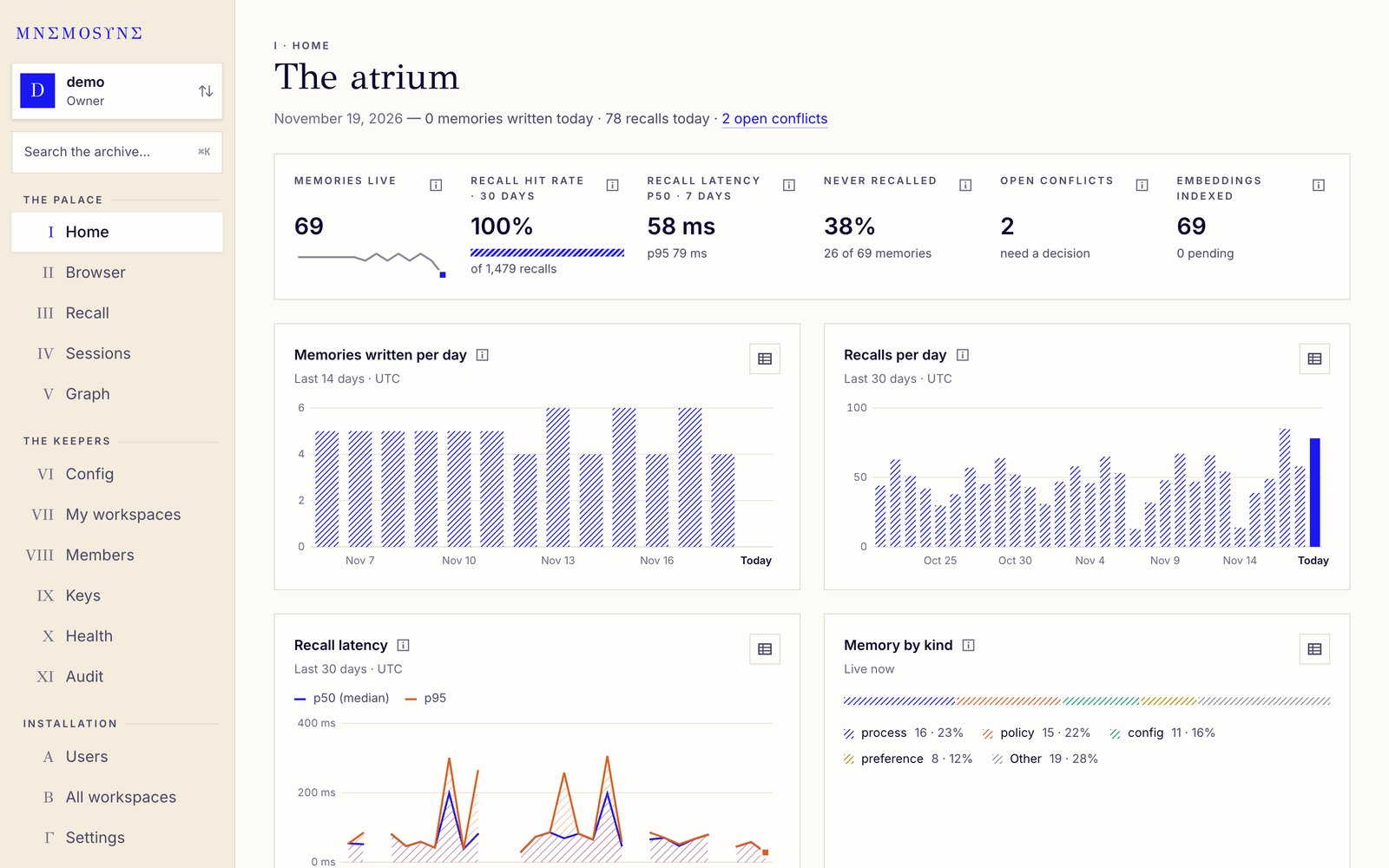
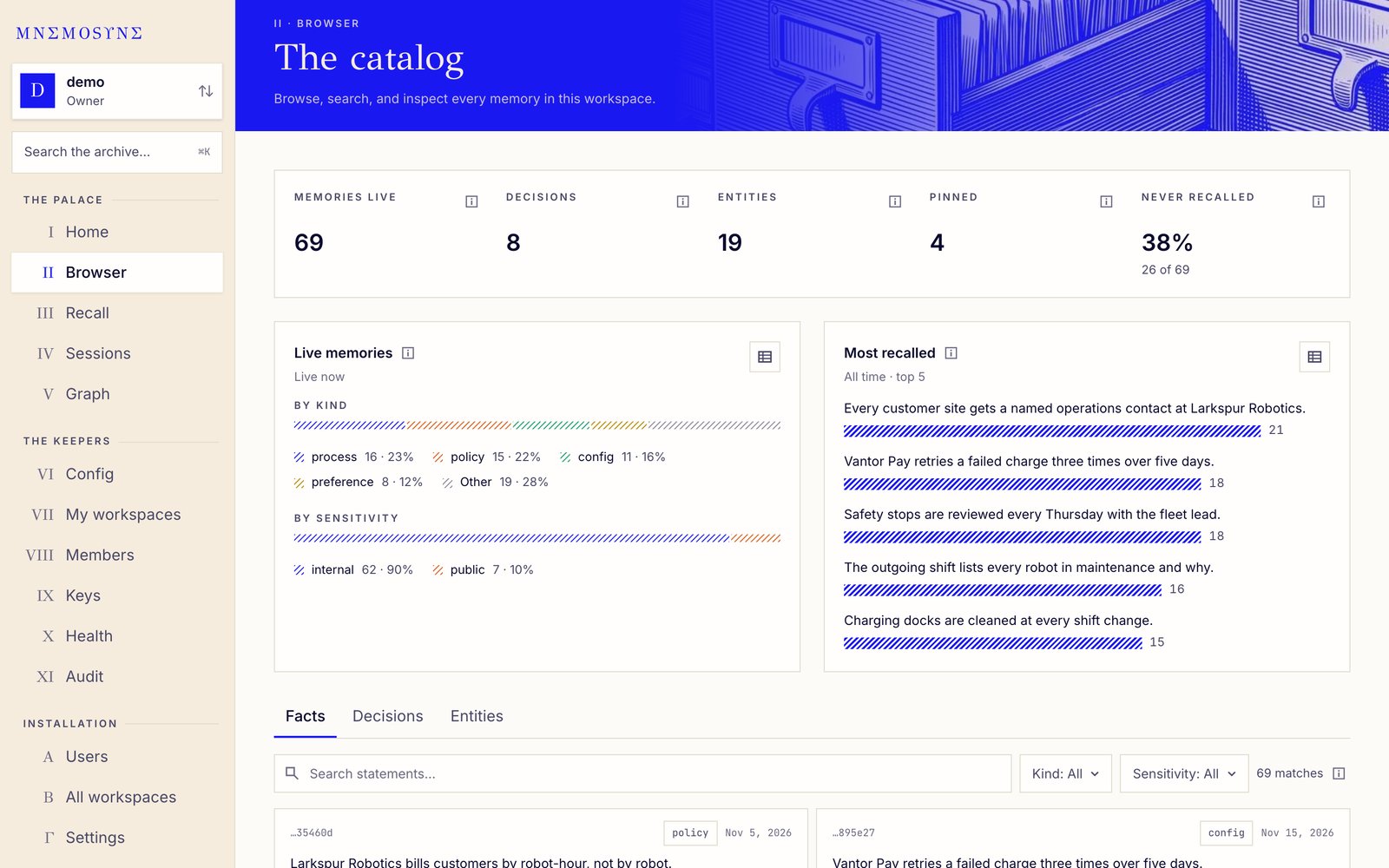
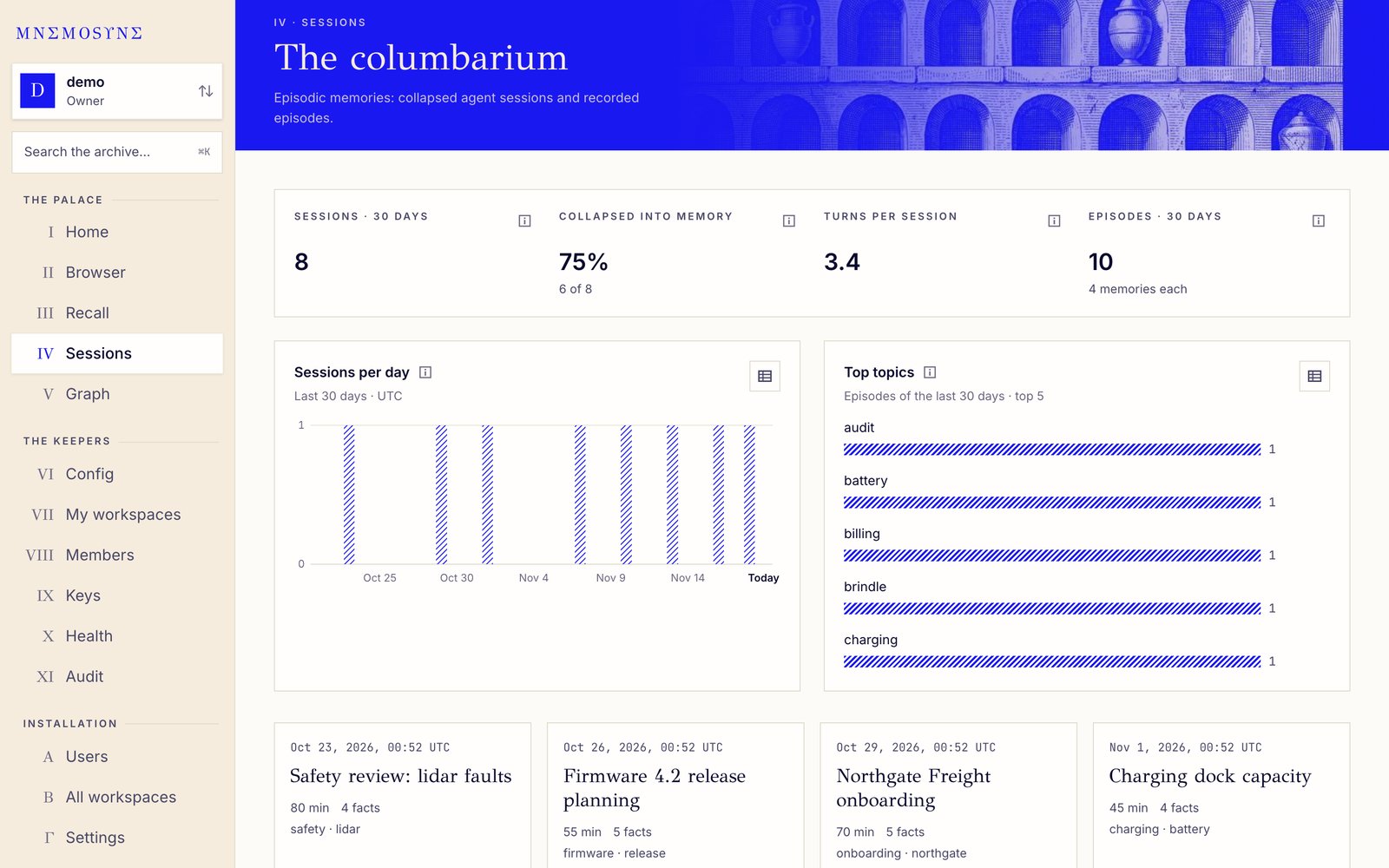
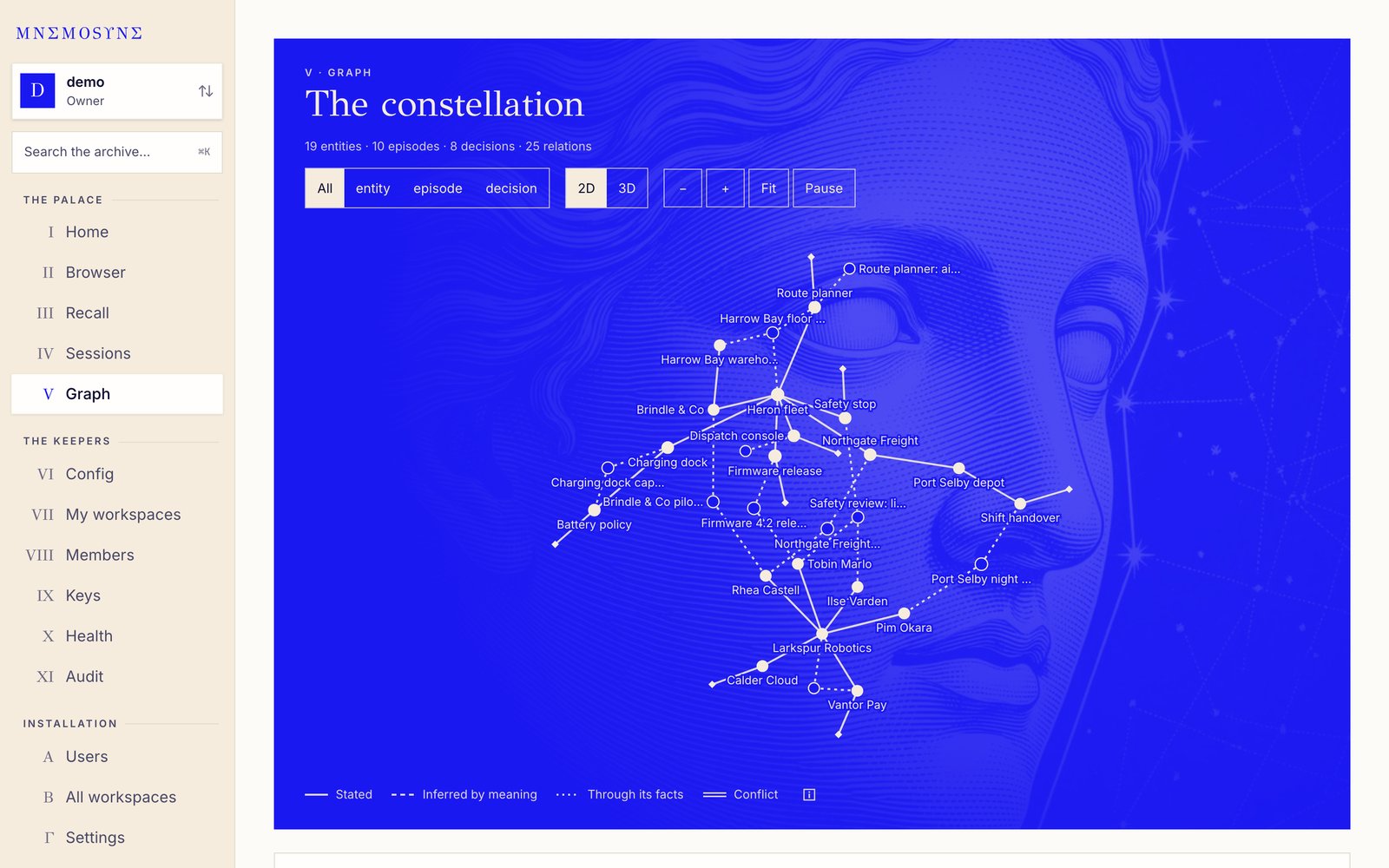
Also inside: the waters of Lethe to test a recall, the frieze for members, the seal for API keys, the herbarium for health and the quipu for the audit log.
The constellation · The memory graph
The Greeks remembered the sky by drawing lines between stars. Mnemosyne does it with what your agents know: entities, episodes and decisions joined by typed relations that carry confidence and provenance. Some are stated, some are inferred by meaning, and some come from the facts two memories share.
19 entities · 10 episodes · 8 decisions · 28 relations
The holdings · What you get
Ten kinds, from facts and decisions to episodes and tasks, each recalled and forgotten in its own way.
Two times on every fact: when it holds in the world and when the system learned it. History is never destroyed, and recall can answer as of any past instant.
Full-text and vector search in one call, with an optional LLM rerank.
Start a session, stream the turns and collapse it: facts, decisions and entities come out.
Contradicting facts are flagged for you or the agent to resolve. A correction keeps the lineage.
A memory that comes back on its own: at a time, or when a condition shows up in a later recall.
Postgres row-level security on every tenant table: the database keeps workspaces apart.
public, internal, confidential and restricted on every memory. A key only reads up to its ceiling.
Personal data is redacted when a memory is written, confidential memories are encrypted at rest, and erasing a person destroys their keys for good.
API keys carry scopes and a ceiling, each agent can get its own policy of scopes, namespaces and rate limits, and sensitive actions can require approval.
An audit log, a timeline of what was learned and when, and export behind an approval.
Give the server a region and each new workspace is pinned to it. A server in another region refuses to serve that workspace.
OpenAI, Anthropic, Google, Cohere, Mistral, Voyage, AWS Bedrock or a local Ollama, even one provider per task. The spend is yours, with an optional daily cap.
MCP server, CLI, TypeScript client, Python and Go SDKs, REST, gRPC and WebSocket.
Webhooks signed with HMAC-SHA256 and live subscriptions over WebSocket.
Two servers share facts through signed, incremental pulls over TLS 1.3. What arrives starts with the lowest trust and comes back in recall marked with its source.
Health checks, a metrics endpoint and four Grafana dashboards.
Load the built-in plugins by name, or your own npm packages, each with its own config, state and sync schedule.
Alpha: the main paths work and are tested, and the API can still change. Several of these features are beta; the status page in the repository marks each one.
The spring of Mnemosyne · How recall works
A recall draws a memory back out of the water. It runs the same seven stages every time, and relevance decides the order: how recently a memory was used can only break a tie.
recall(“how often does firmware ship”)An example recall, on fictional dataI
Turns the question into an embedding and reads the filters of the call: the workspace, how many hits, what this key may see.
query → embedding + filters
One more step is opt-in: a rerank of the page by an LLM, with rerank: true.
The columbarium · Sessions
In a columbarium each niche keeps what is left of one life. Here each niche keeps what is left of one conversation: when it ends, the engine reads it in the background and keeps the facts, decisions and entities worth keeping.
One call when the conversation opens.
User and assistant, as they happen.
The engine extracts what should last. Any later session can recall it.
import { MnemosyneClient } from "@mnemo-ai/client-ts"; const memory = new MnemosyneClient({ url: "http://localhost:3939", apiKey: process.env.MNEMO_KEY!,}); // I. Start a sessionconst session = await memory.createSession({ agentId: "ops-assistant",}); // II. Send each turnawait memory.appendTurn(session.id, { role: "user", content: "Robots keep stopping in aisle 14.",});await memory.appendTurn(session.id, { role: "assistant", content: "Reflective shelves. Firmware 4.2 fixes it.",}); // III. Collapse itawait memory.collapseSession(session.id, { strategy: "auto",}); // Later, from any other sessionconst { hits } = await memory.recall({ query: "why do robots stop in aisle 14", topK: 5,});The Muses · MCP
Mnemosyne’s daughters were the Muses: every art, the myth says, is memory put to work. Her server gives your agent 37 tools in eight families. Connect through MCP and it gets them all; the mnemo CLI covers the same ground.
Write a memory and get it back by meaning, by words or by date.
6 toolsSaves a lasting fact. Saving the same thing twice does not duplicate it.
Brings back the most relevant memories for a question.
Searches by exact words and by meaning, with filters for kind, sensitivity and date.
Opens one fact or decision in full, by its ID.
Shows what changed in a period: what your agent learned this week.
Tells the agent where it is: workspace, user, statistics and the other workspaces in reach.
Change what is known without losing how it came to be known.
5 toolsCorrects a fact by replacing it: the old version closes and the new one keeps the lineage.
Archives a fact. It stops being recalled, stays in the audit trail and can be restored.
Protects a fact from being merged away when duplicates are consolidated.
Moves a fact to another workspace: it closes here and a successor opens there.
Deletes for good. It needs its own permission and is meant for test workspaces.
Name the things your agent talks about and say how they relate.
5 toolsCreates or updates a named thing: a person, an organisation, a project, a concept.
Links two memories with one of nine fixed verbs.
Ties three or more facts together when a pair is not enough.
Records a decision together with the reasons behind it.
Proposes a stable key for a topic, so a new value replaces the old one instead of piling up.
Turn a conversation into memories when it ends.
3 toolsOpens an episode: a named conversation the engine will read later.
Works on the open session: pin a fact, add a turn, collapse it or discard it.
Closes the episode and extracts its facts from the transcript.
Keep what the agent is doing and what it has learned to do.
6 toolsTracks tasks with an owner, a status and dependencies.
Writes an event to the workspace log. Events cannot be edited afterwards.
Stores a chain of thought, from question to conclusion, to use it again.
Keeps reusable rules of the form: when this happens, do that.
Keeps workflow definitions the agent can run again.
Keeps skill definitions the agent can use again.
Find contradictions and duplicates before they mislead.
4 toolsLists facts that contradict each other and resolves them: keep one, keep both or merge.
Puts two facts side by side: what differs and how they relate.
Runs a pass that merges or retires duplicate facts.
Lets the agent edit its own memory: append, replace, strengthen, weaken, reflect or link.
Remember to remember, and know what is missing.
4 toolsSets a reminder that fires at a time or when a condition shows up.
Suggests what the agent will probably need next, from past patterns.
Reports what the agent knows about a subject, where the gaps are and how confidence moves.
Derives new conclusions from recalled facts with declared inference rules.
Check that everything works and manage who is inside.
4 toolsHealth check: the server version and the state of each store.
Workspace figures: live and archived facts, conflicts, embedding coverage and recall hit rate.
Runs eight diagnostics, from database access to tool registration.
Lists workspaces and members, or creates one, invites someone and sets roles.
The threshold · Quickstart
You need Docker with about 8 GB of memory and 12 GB of free disk. The local stack runs Postgres, Redis, the server and a local Ollama, so it needs no cloud API key. The first run takes 5 to 15 minutes.
I Start the stack
git clone https://github.com/lucasmailland/mnemosynecd mnemosyne/dockercp .env.example .envdocker compose up -ddocker exec mnemosyne-ollama ollama pull bge-m3docker exec mnemosyne-ollama ollama pull qwen2.5:3bII Connect your agents
npx -y @mnemo-ai/cli installThe local stack is for trying it out: it does not isolate workspaces from each other. The production setup does.
Read the full guide